Immersive Regional Simulation Center first of its kind in Texas
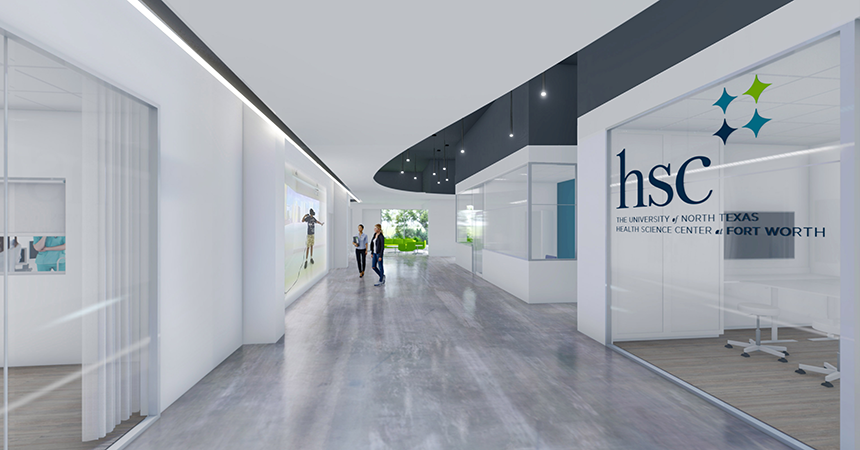
Amid the buzzing activity of construction inside The University of North Texas Health Science Center at Fort Worth Gibson D. Lewis Library sits the future of frontline health care training. Through virtual reality projection rooms, HSC’s new Regional Simulation Center will offer students, faculty and area medical professionals the opportunity to dive into various real-world medical scenarios.
The $6.75 million facility, scheduled to open in late June in a renovated space on the first floor of the library (955 Montgomery St.), will allow users to practice diagnosing and treating a myriad of medical issues in a low-stakes, yet realistic, environment. The center also will serve as a collaborative hub for veteran health care workers to learn new skills and techniques alongside students. The new center also is open for training for hospital residency programs, emergency medical service providers, hospital personnel, nursing home staffers, clinical teams, first responders and more.
The lab’s fully immersive virtual reality projection component uses cutting-edge 360 cameras that allow staff to transport students into on-the-job scenarios. The space is designed to be both efficient and versatile, allowing instructors to recreate any medical setting.
In addition to the virtual reality component, the 16,000-square-foot lab will contain several key improvements over the existing simulation center, which is housed on the fourth floor of HSC’s Medical Education and Training building. The new center will house 14 authentic-looking clinic exam rooms; a large, changeable procedural skills suite; an “activities of daily living” suite designed to look like the inside of a home; several multipurpose “teams” rooms; and plenty of learning lounges, where students can study. Many of the rooms’ functions can be resized, remodeled and adapted based on the learners’ needs.
Karen Meadows, MSN, RN, the program’s director, said one of the big advantages of the new simulation lab will be its accessibility to students.
“No student should leave our university and say, ‘I didn’t have an opportunity to be fully prepared for my future experience,’” she said. “To me, that’s really why the simulation center is here. Some learners take two times through, and they’ve got it down. Others may need eight, and that learner needs the opportunity to come in and practice. The flexibility that this center offers is going to provide that.”
The medical research community has widely accepted that immersive virtual reality training helps learners better retain information, make correct clinical decisions and arrive at those decisions quicker than students who only learn through lectures and two-dimensional simulations. HSC joins a small but growing number of training centers around the country incorporating virtual reality into health care curriculum.
To make the project truly collaborative, Meadows and her staff solicited student and faculty suggestions during the design phase of the new simulation center.
Third-year Texas College of Osteopathic Medicine student and Washington, D.C., native Louisa Weindruch, who plans to apply to an emergency medicine residency next year, was one of the HSC students who offered feedback.
“One of the big things that a lot of the student feedback was focused around was having multifunctional spaces,” she said. Since the space will have to accommodate medical students, nursing students and more, Weindruch imagined alterable rooms.
“We can change from an operating room, to a trauma bay in the E.R., to a home health situation and to a rural disaster medicine-type situation just because of how flexible the lab will be designed,” she said.
Weindruch and other students also encouraged the lab’s designers to include lockers and study areas.
Amogh Krishnagiri, another third-year TCOM student and Allen, Texas, native, was among those whose suggestions shaped the project. He said he was “unbelievably excited” about the new center.
“I think it’s going to really increase the collaboration between the steadily growing medical community at every level,” he said. “We have new residents coming from all over the country in a number of fields. HSC can be the hub where they can come share their intelligence and what they’ve learned with us — not just TCOM students, all students. This is a place where we can bring in undergraduate students and pre-meds and help them really hone in on what they want to do and give them valuable experience.”
Dr. Bharti Chaudhari, simulation director for JPS emergency medicine, called HSC’s new center “a dream come true” for her program.
“You couldn’t ask for better training,” she said. “It is as real as possible yet as deliberate and critical as you need it to be. You’re not just teaching rote memorization; you’re teaching concepts, things that teach students how to think critically. When learners leave this area, they’re going to be a good doctor wherever they go.”
The grand opening for the simulation center will be in late June. The following week, instructors from Harvard University’s Center for Medical Simulation will be in Fort Worth to provide training for HSC faculty. Students and area medical providers will have access to the lab starting in July.
Visit the Regional Simulation Center website to learn more.



Social media