The self-cooling shoe that could reduce amputations
By Alex Branch
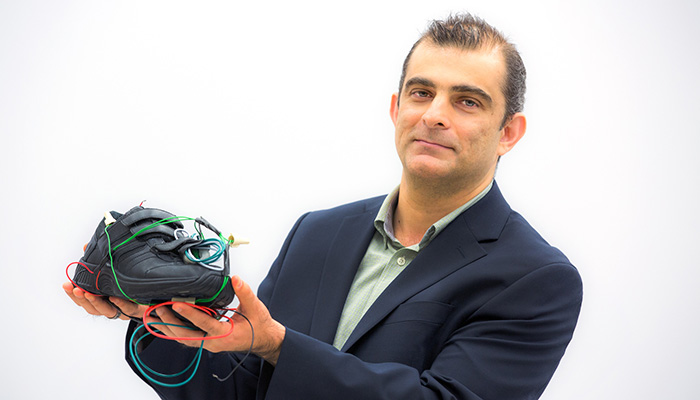
A Health Science Center researcher is creating an innovative shoe that could help prevent dangerous foot ulcers in people with diabetes.
Metin Yavuz, DEng, Assistant Professor of Physical Therapy, has developed a working prototype of a shoe fixed with an electronic cooling system. It’s designed to keep foot tissues from heating to temperatures that can contribute to the development of ulcers.
Foot ulcers are a common and costly problem for people with diabetes. Up to a quarter of diabetics develop an ulcer in their lifetimes, leading to about 100,000 amputations at a cost of $30 billion annually in the United States. People with diabetes often lose sensation in their feet and don’t feel pain from developing wounds.
“We’re basically turning on the A/C inside the shoe,” Dr. Yavuz said. “So far, the results are promising that this could be an effective way to prevent foot ulcers.”
The majority of research into foot ulcers focuses on how pressure that occurs on the foot while walking contributes to ulceration. But Dr. Yavuz is researching the roles of frictional forces and temperature, and how controlling those factors may prevent ulcers.
Using data from his National Institute of Health-funded study, he showed that most diabetic ulcers develop at locations that experience the largest frictional forces. He and his team also studied how elevated temperatures found in the feet of people with diabetes accelerate tissue breakdown. In November, his groundbreaking work was published in two different articles by the journal Diabetes Care.
Regardless of weather conditions, the shoe developed by Dr. Yavuz and research assistant Linda Adams can maintain a temperature around 75 degrees Fahrenheit on the sole of the foot, which could otherwise reach 100 degrees in diabetic people. By controlling temperatures, the foot tissue should suffer less damage.
Dr. Yavuz recently received a nearly $500,000 grant from the National Institute of Diabetes and Digestive and Kidney Diseases to further his research.
“Foot ulcers are an enormous problem and development of a novel shoe that could help prevent them has long been a goal of mine,” Dr. Yavuz said. “There is still a lot of work left to do, but we’re making progress.”





Social media