Taking aim at metastatic prostate cancer
By Jan Jarvis
When prostate cancer spreads to the bone it can be challenging to treat and often results in pain, fractures and limited survival.
But an approach that delivers chemotherapy directly to the cancerous bone lesions shows promise as a new treatment that reduces tumor size and relieves pain for men with advanced prostate cancer.
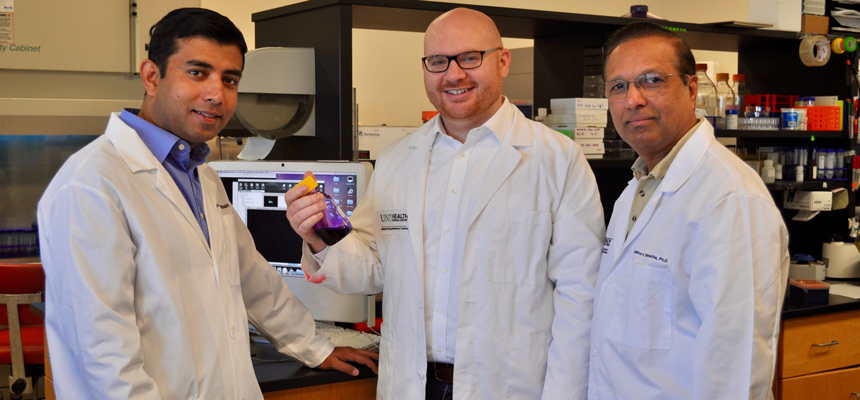
Researchers at UNT Health Science Center have used nanotechology to target cancer that has spread to the bone, and their research was recently highlighted at the American Association of Pharmaceutical Scientists Annual Meeting and Exposition in San Diego.
Using this approach, it’s possible to treat the bone lesion more precisely, said Jamboor K. Vishwanatha, PhD, Regents Professor of Biomedical Science and Vice President for Diversity and International Programs.
“When prostate cancer spreads to the bone, which it frequently does, it reduces quality of life, causes pain and leads to bone loss,” Dr. Vishwanatha said. “Metastatic prostate cancer is also very lethal.”
Prostate cancer is the second most common cause of cancer death among American men. Each year about 161,000 new cases of prostate cancer are diagnosed, and there are about 26,700 deaths.
At diagnosis, the majority of prostate cancer patients have disease that is localized to the prostate and can be treated or followed with watchful waiting, said Andrew Gdowski, DO/PhD student and lead author on the study.
“These patients have very good outcomes,” he said. “However, some patients have metastatic prostate cancer at diagnosis and the outcomes are far less favorable, with a 5-year relative survival rate of 29 percent.”
While there are some new treatments for prostate cancer, it can be difficult to treat these metastatic bone lesions as they are often not responsive and the therapies cause side effects.
Dr. Vishwanatha and his team wanted to develop an approach to treat or eliminate the tumor and preserve quality of life. Their approach was to use targeted polymeric nanoparticles to deliver the drug cabazitaxel directly to the bone. The nanoparticle released the drug within the first eight hours. with sustained release for up to 72 hours.
“We anticipate this will reduce off-target side effects, because the drug was preferentially delivered to the tumor,” Dr. Vishwanatha said.
In the study, mice that received targeted nanoparticle treatment had no bone lesions appear on x-rays, compared to one-third in the non-targeted group.
“The targeted nanoparticles not only decreased tumor size but also helped maintain bone structure and reduce pain”, said Amalendu Ranjan, PhD, Research Assistant Professor of Biomedical Sciences and lead team member.
Pain assessments were conducted and evaluated in collaboration with Marjana Sarker, PhD, from the Pharmacology and Neuroscience department.
A similar therapeutic is also being studied for the treatment of metastatic breast cancer.
The research is funded by a grant from the Cancer Prevention and Research Institute of Texas.
The next step is to move into a pre-clinical study to test for toxicity.
“We’re looking at a clinical application down the road,” Dr. Vishwanatha said.






Social media